The Collegian Effect
Kenyon produces top journalists without offering a journalism degree.
Read The StoryKenyon’s liberal arts approach to AI and computing prepares students to shape — and question — the technologies around them.
Story by Erin Peterson | Illustrations by Michael Haddad
When Wisdom Akanwe ’27 dreamed up a project for his “Introduction to Programming” class with mathematics and computer science professor James Skon his first year, he wasn’t interested in changing the world. He just wanted to figure out what to wear in it.
“I’m from Ghana, where we use Celsius instead of Fahrenheit,” he explained. “I would see a temperature of 44 (a Celsius equivalent to a sweltering 111 degrees Fahrenheit), and I would assume that it was hot out, not that I would almost freeze to death.”
So, as part of his coursework, he created a program — which he coded himself and then reviewed with the help of artificial intelligence (AI) tools — where he entered a temperature, with the program matching it to a weather-appropriate outfit he already owned. “It saved me 10 minutes (every morning),” he said. “I didn’t need to worry about anything.”
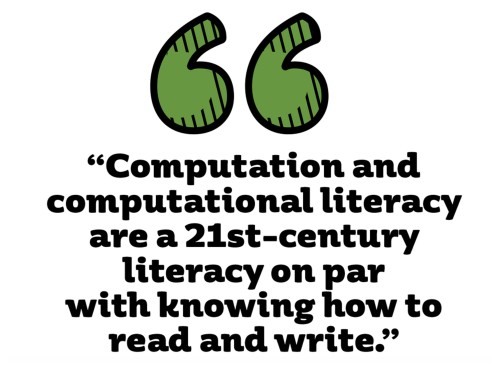
On its surface, the project was a technical exercise. But it was also a way of thinking about how to solve problems — and it reflects something R. Jordan Crouser, founding director of the Interdisciplinary Program in Computing, sees happening everywhere. What was once the province of specialists is increasingly central to how people learn and work. “Computation and computational literacy are a 21st-century literacy on par with knowing how to read and write,” he said.
At a moment of rapid technological change, Kenyon is building a model that brings together three distinct strengths: a new interdisciplinary computing program that welcomes students from every field, nationally recognized expertise in artificial intelligence, and the ethical grounding and flexible thinking of a liberal arts education.
Together, they ensure that students don’t just learn how to use powerful technologies, but how to question, shape and apply them responsibly in whatever paths they pursue.
As a postdoc in the 1990s, Karen Hicks, Peter Rutkoff Distinguished Professor in Diversity and Inclusion and Professor of Biology, spent five years working to clone a gene based on a mutant phenotype. Today, thanks to technological advances and falling costs, students in her research group can tackle similarly ambitious questions in a matter of months.
“I’m jealous of them, but it’s so exciting,” she said.
And any student — whether or not they pursue further research with Hicks — can develop the skills to use sequencing technology to analyze genomic data in Hicks’ “Computational Genomics” course, which bridges biology and computing using a high-performance computing cluster.
It’s a course that embodies the larger vision of the Interdisciplinary Program in Computing: computing embedded in the areas students are already passionate about, not treated as a stand-alone discipline. The approach mirrors how the technology actually gets used in the world.
When Crouser started last summer as the program’s founding director, he received valuable input from faculty members and administrators, but he felt like he needed more. So, Crouser asked his students for help.
“What I realized I was really missing was a group of student voices to help me think through what this program needs to look like,” he said.
Over the course of the fall semester, 10 students in Crouser’s special topics seminar, “Introduction to Design Thinking,” helped build a better picture of what a forward-thinking program consistent with the College’s values, existing coursework in computing, and student needs could be.
The group made a compelling case that a defining feature should be early access to intellectually exciting topics without gatekeeping prerequisites. That insight directly shaped this spring’s course offerings, including “Contemporary Topics in Computing,” a course on digital security that spans hardware, software and human systems.
“Very few institutions offer a course like this at such an accessible entry point, and it’s a concrete example of how student feedback translated into an immediate teaching decision,” Crouser said.
The goal, Crouser said, is to lower barriers and invite students from across disciplines into meaningful engagement with computing. “For economics majors, that might mean a course in quantitative economics that focuses on why market fluctuations are so difficult to predict. For political science majors, it might be a course in AI governance and policy. For artists, it might mean a course in new media, where an immersive classroom allows students to project something on every surface,” he said. “I want every single student to be able to look at the courses we offer and see themselves reflected there.”
Elizabeth Aiken ’26 took Crouser’s design class despite having never taken a computing class before at Kenyon. She said the group took its work seriously, conducting stakeholder interviews with administrators, faculty and staff, and was excited for its input to be considered by the College.
“I was constantly impressed with and inspired by the recommendations that my classmates made. It was exciting to feel everyone’s energy for the new computing department,” she said. “And it was special that Jordan trusted us enough with our insights about Kenyon students, values and academics to value our opinions so highly.”
To help the class better understand the interdisciplinary possibilities involved, students created a “course remixer” that allows users to make mash-ups of any pair of Kenyon classes. And as a final project, the class — which recommended student representation on the program’s steering committee — built an “Oregon Trail”-style video game that lets people explore various governance structure decisions and their potential ripple effects.
Crouser’s students are also collaborating on funded research, including a grant from the Laboratory for Analytic Sciences to develop tools for evaluating whether AI systems can be trusted in real-world decision making.
From Alumni Magazine - Spring 2026


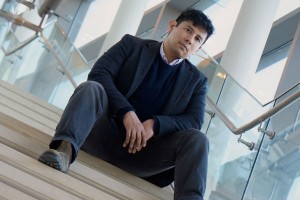
Crouser sees particular value in this deeper expertise for students as AI becomes more embedded in our everyday lives. “I think of it like this: you can drive a car without knowing what’s under the hood. But to design the next generation of fuel-efficient or higher-capacity vehicles, you’ll need to pop the hood. We need to under-stand how it works, not just how to work it.”
Associate Professor of Physics Madeline Wade has applied that philosophy to her own work with students. Wade was part of the team that made the first direct detection of gravitational waves in 2015 using LIGO, the Laser Interferometer Gravitational-Wave Observatory — the massive computational challenge and landmark discovery that confirmed Einstein’s theory of general relativity. The work has been recognized with the Princess of Asturias Award, the Gruber Prize in Cosmology and the Breakthrough Prize in Fundamental Physics.
Every summer, several students join her on projects linked to the LIGO Scientific Collaboration, one of the international collaborations that detect gravitational waves from black hole collisions. Over the years, students have painstakingly curated data sets and built neural networks — computer systems modeled on the human brain and nervous system — essentially from the ground up. Today’s students continue the work, but at a much faster clip with the help of AI.
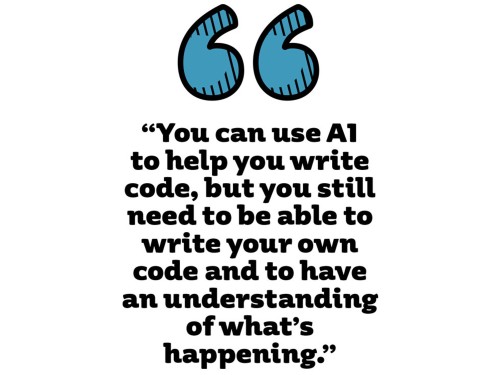
The key, Wade said, is that speed doesn’t replace students’ depth of knowledge. “The students need to deeply understand the code they’re working with (so they can) synthesize new things. You can use AI to help you write code, but you still need to be able to write your own code and to have an understanding of what’s happening.”
The Interdisciplinary Program in Computing is designed around a core group of faculty with computing expertise and will ultimately partner with up to 30 additional faculty from other departments who have a strong interest in computing.
The approach swaps out the highly sequenced coursework common to many computing programs in favor of a structure that looks more like Kenyon’s history department, which has dozens of classes with no prerequisites. “You can still have many courses chained together in meaningful sequences, but there’s no gatekeeping,” Crouser explained.
For professors already teaching these interdisciplinary classes, the richness of the classroom experience is undeniable. Emily Zeller ’08, visiting assistant professor of art and studio art technology specialist, teaches a creative coding class that attracts students with a range of backgrounds. And whether they arrive with artistic or computational expertise, all navigate real vulnerability. “For those who are new to coding, I try to make it accessible enough that they won’t get lost, and for those who have never participated in (an art) critique before, I try to help them have that dialogue,” she said.
In her class, students have created visual novels, sound-reactive pieces, and projects pairing sections of a Toni Morrison novel with images from the National Gallery of Art. “Sometimes, you’ll see the moment where a student gets art in a way that they haven’t before,” she said — moments that expand students’ sense of possibility.
Catherine Liu ’29 knows that sense of expansive potential well. When she arrived at Kenyon, she expected to pursue biology, and her only computing interest began and ended with the vague idea that she might someday like to develop a video game.
But after taking courses with Crouser in design thinking and cybersecurity, she realized how many interesting questions — about ethics, empathy, human psychology and societal impact — computing could illuminate. “I came in with a narrow interest,” she said. “And now it’s much wider.”
The reimagining of the program does more than just open and expand computing on campus: it puts an emphasis on the discipline that has become increasingly important in our technology-immersed world, said Crouser. “Letting go of the traditional siloing of computing allows us to leap ahead and innovate.”
Kenyon is reimagining computing at the same moment AI seems to be upending everything else.
It was a revolution that Katherine Elkins and Jon Chun saw coming. While most of the world got wowed by AI in late 2022, when ChatGPT was released to the public by OpenAI, Elkins, professor of comparative literature and humanities and director of the Integrated Program in Humane Studies, and Chun, co-principal investigator of the Schmidt Sciences Humanities and AI Virtual Institute (HAVI) project and visiting instructor of humanities, had co-founded the human-centered AI curriculum at Kenyon in 2016. It was a six-year head start that sharpened their understanding of the technology’s unique power and peril.
They each contributed distinctive strengths to the program: Elkins, a recognized AI researcher whose work has focused on bias detection, sentiment analysis and the ethical evaluation of models — and who was awarded the National Endowment for the Humanities Teaching Professorship for curriculum innovation — brought a unique perspective on the capabilities and limitations of AI. Chun, a co-founder of SafeWeb, the world’s largest privacy and anonymity platform, had built a career focused on issues linked to online security, safety and privacy.
While others focused on AI’s potential to boost productivity and cure diseases, Elkins and Chun brought rigorous research and clear-eyed analysis to the technology’s potential dangers and opportunities, from artistic exploitation and mass job loss to analyzing empathetic healthcare narratives and rescuing endangered historical records.
The pair didn’t dispute the idea that AI would be transformative, but they did worry that many of today’s brilliant AI builders might not bring the deep humanity of philosophy, literature and art to the technologies they were creating. They believed that Kenyon, with its liberal arts grounding, could prepare leaders who would. “We need people with (that kind of humanistic perspective) as we build the future of AI,” said Chun.
So, while AI’s possibilities burbled just beneath the surface for most of the world, Elkins and Chun brought early insights to students through courses such as “Programming Humanity” and “AI for Humanity” in the Integrated Program in Humane Studies (IPHS). Founded in 1975, IPHS is Kenyon’s oldest interdisciplinary program, grounding students in humanistic inquiry.
Raul Romero ’22, now a product manager at eBay, remembers these early days with crystal clarity. He took four interlinked classes with the two professors in 2021 and early 2022 that focused on AI, its workings and its impact on humanity. “Even before that mainstream moment of ChatGPT, we were learning things like logistic regressions, different machine learning models and deep neural networks,” he said.
When ChatGPT finally went mainstream, there was a cohort of students and young alumni at Kenyon who were more than ready for the moment. “So many people were saying: ‘What is this crazy thing?’” recalled Abby Foster ’23. “But I’d already gotten a strong foundation from my classes. I had studied the technology, and ChatGPT was an application of it — a version of what had already been happening for a long time.”
Throughout these courses, students write code, build computational models, and work with real data alongside questions about AI’s implications for power, accountability and human agency. In “AI for Humanity,” students code technical solutions to problems they’ve debated ethically. Class discussions can get heated, but they’re also illuminating, in part because they’re anything but theoretical. “Many students initially say they don’t want to pick an imperfect solution, even though there is no perfect solution,” said Elkins. But over time, one of the most exciting things to see, she said, is a student faced with a genuinely hard technical challenge — programming a solution to de-bias a machine learning system, for example — who raises their hand and says: “I will do it.”
“Yes, it’s messy. There are downstream effects and it’s a complex world,” Elkins added. “But I want these students at the (decision-making) tables.”
Their approach isn’t valued just at Kenyon: Elkins and Chun are sought-out experts and voices nationwide. As principal investigators, they received an award of up to $330,000 from HAVI to develop an open-access AI system to rescue endangered archives in underrepresented communities, focusing on historical repositories in New Orleans, home to aging materials related to Creole, Cajun and jazz history. They were also appointed principal investigators representing the Modern Language Association — a 25,000-member scholarly organization — on the U.S. AI Safety Institute’s team, and were members of Meta’s Open Innovation AI Research Community.
Today’s students, meanwhile, continue to push their learning in unexpected directions. English major Marisol Hernandez Brito ’26 said her coursework in AI has helped her explore her discipline in unique ways: in recent years, she has studied immigrant narratives and thriller novel templates through the lens of AI.
Her own disciplinary expertise primes her to ask questions and probe ethical tensions in her work. “I’m asking whose stories are being told, what patterns are being reinforced through these machines, and what this means for creativity,” she said. “And I can ask these questions meaningfully not only because I have a profound love for the arts, but also because I understand the technical foundations of these machines.”
It is that knowledge, she said, that gives her confidence that she can ultimately harness AI’s capabilities effectively and apply them in ways that remain deeply human. At a moment when conversations about AI often swing between hype and alarm, Kenyon’s approach has been neither overly fearful nor naively optimistic. Alumni working at the leading edge of the field recognize that posture as familiar.
Tris Warkentin ’05, now a director of product management for DeepMind leading research and development of Gemini models, said the way he learned to think at Kenyon continues to shape how he navigates his work and how he responds to change. “I do think that learning how to learn, understanding how to adapt to your surroundings and internalizing what adaptability of the mind means — that’s truly important.”
It’s a way of approaching the technology and its impact that likely looks familiar to generations of Kenyon alumni, and that will continue to matter as AI reshapes the world.

As students harness AI to push their work further, faculty are navigating a parallel challenge: ensuring the technology doesn’t shortcut the learning itself. For professors like Zeller, the tension is constant.
The same AI tools that can help an experienced coder catch errors can become a crutch for a beginner. “If they’re never learning the basics — if they use it too early — they’re not just going to have a bad time later on,” she said. “They’re also on a slippery slope toward plagiarism.” Faculty across disciplines are grappling with the same question: how to let AI accelerate learning without letting it replace it.
James Skon said he was never particularly eager to read students’ blue book scrawlings (“people don’t write programs on paper, anyway”), so he built a locked-down digital platform that allows students to complete exams on a computer while preventing the use of AI. It’s a solution, he said, that offers the integrity of a blue book without the drawbacks of handwritten responses.
But the project of teaching in the age of AI is an evolving one, and one that no faculty say they have all the answers to. “I want students to know they can always ask me about it — this is not about ‘Oh, I caught you using AI,’ — that’s never the goal. It’s something we figure out together,” said Zeller.
While faculty and students navigate the role of AI in classes together, the impact of student work on AI-fueled projects is undeniable. Since 2018, nearly 200 student projects have been posted on Digital Kenyon.
The work runs the gamut: Gwen Eisenbeis ’26 built an AI model to simulate elite-level swim coaching, and Juliette Lowe ’25 developed a model to diagnose specific types of pediatric rheumatological disorders. Hemmi Song ’24 analyzed how the emotional tone of popular music on Spotify changed over the course of the pandemic. Students have used AI to analyze the Mamdani campaign, Supreme Court decisions and advice from financial advisors.
This mentored, original student research done through IPHS has attracted broad scholarly and media interest. Overall, the student work and projects have been downloaded more than 99,000 times.
While the projects that students are doing in the classroom are garnering plenty of outside interest, students also leverage their work to go beyond campus boundaries and pursue projects they’re passionate about, both as students and as alumni.
After creating his temperature-based outfit planning tool, Akanwe teamed up with Skon and other Kenyon students this past summer to work on software for a school management system designed to support hundreds of schools across Belize.
Foster, meanwhile, has spent the past two years at the National Gallery of Art in Washington, D.C. There, she undertook an AI initiative involving a WPA-era collection of thousands of detailed watercolor paintings and archival records.
Her work has focused on applying AI tools to extract searchable text from tens of thousands of scanned data sheets linked to the paintings and records. The work will provide a foundation for the museum to provide richer, more connected information for researchers and the public. “A lot of museums are really embracing this emerging technology,” she said. “These are tools that can help people look through collections in new ways.”
While Foster loves what she’s been able to accomplish at the museum, she also feels that her opportunities are almost limitless. “The skills that IPHS classes taught me — the ability to work with new technologies, to understand what is actually happening, the ability to speak with authority in terms of (a technology’s) capability — are some of the most important skills there are right now,” she said. “I feel like they’re very in-demand.”
Similarly, Romero’s early introduction to the foundations of AI have given him grounding to scale the corporate ladder with remarkable speed. This has included roles that allow him to work on AI-fueled projects for eBay that recommend complementary clothing and accessories based on customer browsing behavior.
But Romero is quick to note that it’s not just his technical chops that have helped him succeed in a role that requires him to translate between the needs of engineers, designers and customers. He’s also relied on the communication skills he learned in Kenyon’s classrooms. “It was such a hands-on environment. You’re having engaging discussions and you’re (listening) to different points of view,” he said. “Those are experiences that helped prepare me and gave me confidence in ways that lecture-only classes couldn’t have.”
In an era when technology is moving fast, these human skills are what allow students, and their ideas, to flourish.
Akanwe’s horizons, meanwhile, continue to expand. After his summer work building software for schools in Belize, he competed in the HackOHI/O hackathon with a small team that included Godwin Idowu ’27.
The team’s entry, an AI-infused platform called Pchz that connects developers with tech ideas to recruiters and investors, won the “most original” award, which has opened the door to a future meeting with Y Combinator, the startup accelerator behind companies including Airbnb, Instacart and Dropbox. He calls the experience “surreal,” and in many ways, it is.
His journey started with a project to solve a small, personal problem and has grown to encompass a far larger vision. He has benefited from learning the underlying technology, speeding his work through AI, building connections with real people, and strengthening his skills as a communicator and a collaborator. Kenyon, he said, “equipped us with the skills, frameworks and mindset to actually build impactful technology. The foundation translates beyond assignments into real-world outcomes.”
Ryan E. Smith contributed reporting to this feature.
Kenyon produces top journalists without offering a journalism degree.
Read The StoryVirginia McBride ’15 uses an interdisciplinary approach at the Metropolitan Museum of Art to work with photographs…
Read The Story