The Collegian Effect
Kenyon produces top journalists without offering a journalism degree.
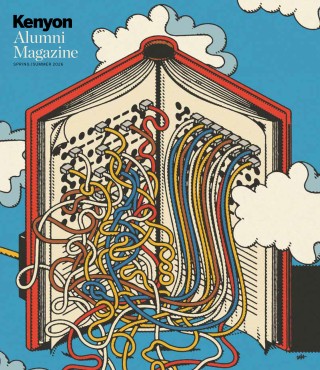
Read The StoryOutgoing editor Elizabeth Weinstein reflects on her tenure at the helm of Kenyon’s alumni magazine and the cultural value of print media.
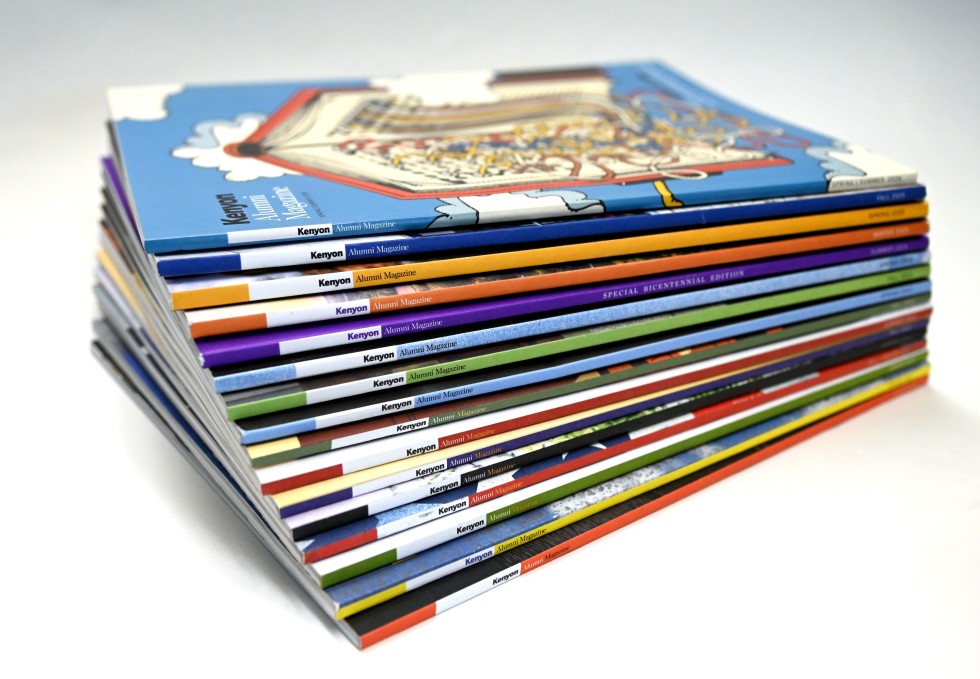
Every issue of this magazine contains an argument — quiet or otherwise — about why print media matters. I’ve made that case in meetings, in late-night rewrites, and in my own head more times than I can count. But I hadn’t found the right words until earlier this year, when my longtime favorite musician, Brandi Carlile, found them for me.
In a fan livestream before a recent album release, Carlile talked about the significance of the word “album” — not just the music, but the object. As a kid, she owned Elton John’s “Goodbye Yellow Brick Road” on cassette, and she studied the gatefold insert closely, memorizing the band members’ faces, the lyrics and the artwork that accompanied each song. “Bennie and the Jets” had comic book characters. The cryptic “Grey Seal” had a phoenix on fire.
“I had a Walkman, and I listened to that album day in and day out — in the car, everywhere. I didn’t talk to people; I just had ‘Yellow Brick Road’ in my ears and the gatefold in my hands. It was an album. It was a whole immersive experience — better than a movie, better than a carnival,” she said.
One day on her school bus, some junior-high boys ran a magnet over her tape, rendering it unplayable. She was devastated, but she kept the tape and insert. She’d already learned the music by heart, so when she read the lyrics, she could still hear the melodies in her mind.
“That’s when I decided albums were more than music. Albums were real things — something you had to be able to hold in your hands,” she said. “You don’t forget the physical.”
We have a record player and dozens of vinyl albums (including several by Carlile) in our living room, and I’ve watched my 2-year-old experience the magic of listening to a record while holding the open liner notes in his tiny hands. To him, listening to music any other way is an inferior sensory experience. He remembers his favorite album covers and can point to their exact locations on our shelf.
Print magazines are similar. It’s easy to forget links and phone notifications, and harder to forget the publication you held in your lap after a long day, full of stories that made you feel nostalgic for your own college years.
It has been an honor to spend the past 10 years editing the magazine you are holding in your hands. Thank you to everyone who has entrusted me — and Kenyon — with your life updates, stories and ideas. This is my final editor’s note for Kenyon Alumni Magazine. I’ve spent these years working with a team of talented writers, editors, proofreaders, artists, photographers and designers, making something worth keeping, and I’ll never forget it. Farewell, Old Kenyon. Fare thee well.
Photography by Adam Gilson.
Posted in
Arts & CultureAuthor
Elizabeth WeinsteinFrom Alumni Magazine - Spring 2026
Kenyon produces top journalists without offering a journalism degree.
Read The StoryVirginia McBride ’15 uses an interdisciplinary approach at the Metropolitan Museum of Art to work with photographs…
Read The StoryKenyon’s liberal arts approach to AI and computing prepares students to shape — and question — the technologies…
Read The Story