The Collegian Effect
Kenyon produces top journalists without offering a journalism degree.
Read The StoryHewlet McFarlane and Joel Richeimer take a conscious approach to teaching for their course “Neurophilosophy of Consciousness.”
Tuesdays and Thursdays, 9:40 - 11 a.m., Oden Hall 400
What exactly is human consciousness?
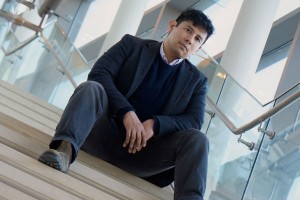
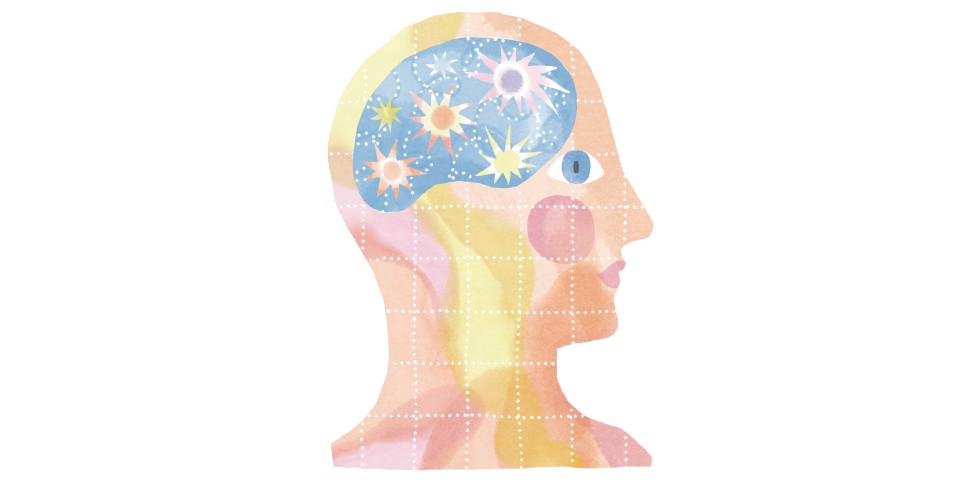
If there’s one thing that Professor of Neuroscience Hewlet McFarlane and Professor of Philosophy Joel Richeimer can agree on, it’s that they don’t know. But listening to them go back and forth on the topic — often while disagreeing — is what makes “Neurophilosophy of Consciousness,” the seminar they’ve been teaching together since 2016, so much fun — and so meaningful.
“We’ve been having these kinds of arguments outside of class for many years,” McFarlane said. “Our decision to teach this class really was bringing into the classroom the kind of conversations we have outside the classroom.”
A founding member of Kenyon’s neuroscience department, McFarlane arrived at Kenyon in 1998. His research interests focus on the relationships between brain chemistry and behavior with particular emphasis on mental illness. He also serves the College as assistant vice president for enrollment and director of strategic programs and partnerships.
Richeimer, who has taught philosophy at the College since 1992, focuses on the philosophy of perception. In November, he received Kenyon’s Faculty Advising Award. Together, their different disciplinary lenses guide a course built around exploring what it means to be conscious.
Neuroscientists, philosophers, linguists, anthropologists and physicists all bring different approaches to investigating human consciousness. To some, it’s a yet-to-be-discovered biological function of the brain; to others, it’s a question of quantum phenomena, not neurons. Maybe the key to understanding it is information processing and language. Or maybe it’s none of the above. “This area we’re teaching is a frontier,” Richeimer said. “There’s a lot of room for disagreement and a lot of speculation. So it lends itself to conversation.”
Modern technology and scientific breakthroughs have only enriched the age-old dialogue. “Even though consciousness is an old topic, in terms of a systematic scientific approach, it’s a new topic,” Richeimer said. “We are at the beginning of something, not the end.”
The class, which is limited to seniors and well-prepared juniors — most of whom are either neuroscience or philosophy majors — asks a lot of students. They must read and present contemporary journal articles from academics across disciplines who can’t offer definitive solutions. “It takes a different kind of student to want to take this class,” McFarlane said. “If you’re a student who wants to know the answer to the question — you want to put in the formula and get an output and that’s the answer — this is a difficult class for you because that doesn’t happen.”
Instead, students are expected to follow the example of their teachers as they wrestle with complicated ideas and engage in spirited debate. “It is a class where you bring your questions. You defend your ideas. You examine other people’s ideas. You try to figure out where their logic falls apart and where your logic falls apart,” McFarlane said.
And that’s by design. “We’re not just teaching; we’re trying to model civil disagreement, which we both feel may be lacking in this culture,” Richeimer said. “And so part of it is we disagree, but we listen to each other. We respond to each other.”
“Phantoms in the Brain: Probing the Mysteries of the Human Mind,” by V.S. Ramachandran and Sandra Blakeslee
“The Nature of Consciousness: Philosophical Debates,” edited by Ned Block, Owen J. Flanagan and Guven Guzeldere
Web extra: From dance, film and literature to science and international relations, Kenyon professors give brief overviews of some of their favorite courses. VIEW FULL PLAYLIST
Posted in
General KenyonAuthor
Ryan E. SmithFrom Alumni Magazine - Spring 2026

Kenyon produces top journalists without offering a journalism degree.
Read The StoryKenyon’s liberal arts approach to AI and computing prepares students to shape — and question — the technologies…
Read The StoryVirginia McBride ’15 uses an interdisciplinary approach at the Metropolitan Museum of Art to work with photographs…
Read The Story